
Rubber Backed Ceramic Pulley Lagging
Rubber Backed Ceramic Pulley Lagging
Gecko Tread
Gecko Tread
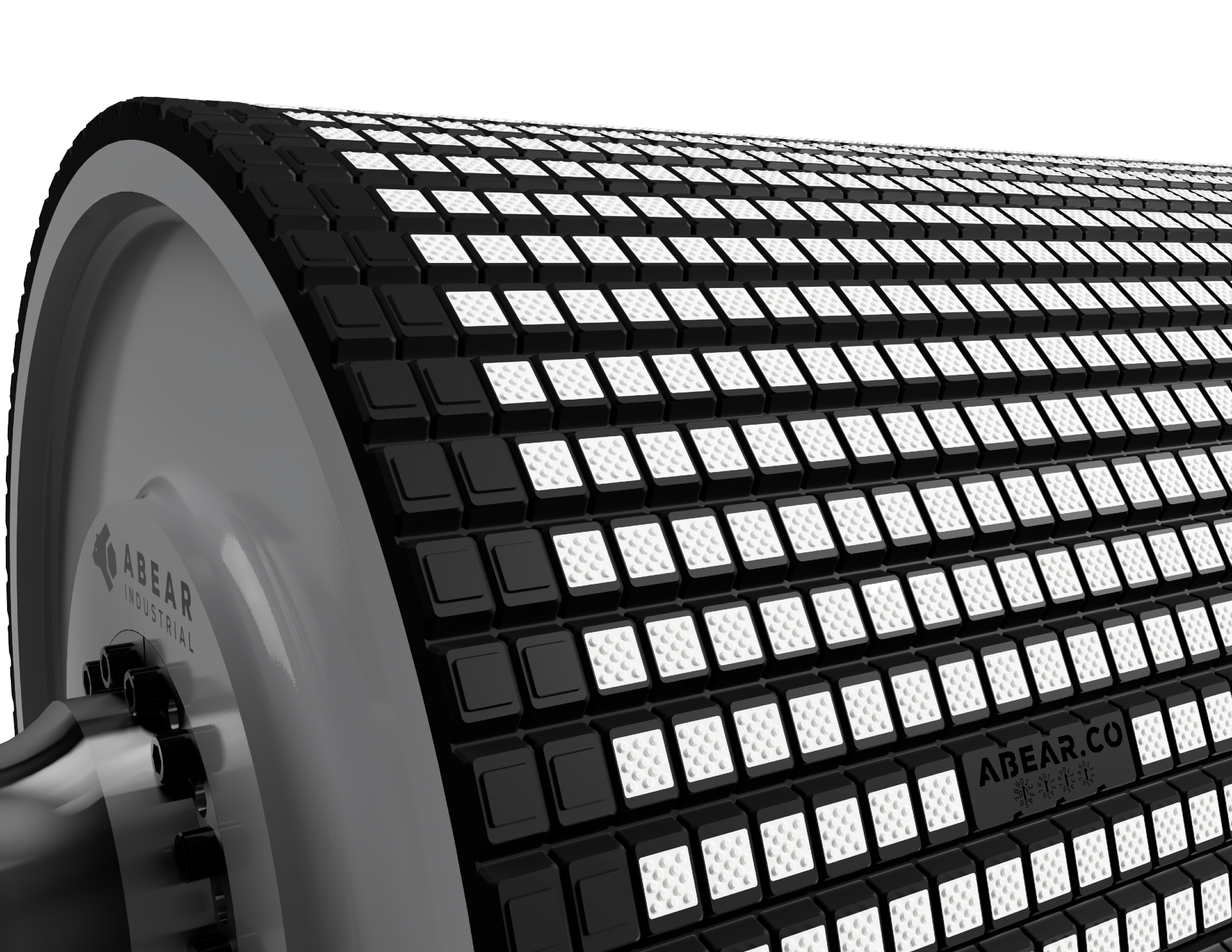
ABEAR Industrial’s square tile ceramic pulley lagging solution, engineered to significantly reduce the Total Cost of Ownership. It delivers exceptional traction across all operating conditions and offers an unmatched service life.

Anti-Resonance

Easy Installation

Flexible

Reduced TCO
Anti-Resonance
Easy Installation
Flexible
Reduced TCO
Anti-Resonance
Easy Installation
Flexible
Reduced
TCO
OVERALL FEATURES
GECKO TREAD is ABEAR Industrial’s square tile ceramic pulley lagging solution, engineered to significantly reduce the Total Cost of Ownership. It delivers exceptional traction across all operating conditions and offers an unmatched service life.
The advanced anti-resonance design further enhances the conveyor system performance by extending the lifespan of key mechanical components, including bearings, gearboxes, and other elements of the conveyor system.
The reduced Total Cost of Ownership is achieved not only through extended pulley lagging service life, but also through smoother system operation and improved conveyor belt service-life.
The Alumina Ceramic Tiles are engineered for maximum traction and belt protection. Embedded within semi-independent tread blocks, they deliver superior grip while minimizing wear on the conveyor belt.
The tread blocks and grooves are engineered for efficient material expulsion, ensuring exceptional traction under demanding conditions.
Operating Conditions:

Dry

Wet

Mud

Ice
HIGHLIGHTS
HIGHLIGHTS


Performance Attributes
Bonding Technology | |
|---|---|
Type | ABEAR CN Bonding Layer |
Bond Strength (N/mm) | >20 |
Use Case | |
Type | ABEAR Hot Vulcanised (HV) |
Bond Strength (N/mm) | >25 |
Use Case |
|
Bonding Technology | ||||
|---|---|---|---|---|
Type | Bond Strength (N/mm) | Use Case | ||
ABEAR CN Bonding Layer | >20 |
| ||
ABEAR Hot Vulcanised (HV) | >25 |
| ||
Supply Options

Strip (with Rubber Ends)

Roll (Cut-To-Size on Application)
Quick Sizing Guide
This table offers a practical guideline applicable to most standard use cases.
Thicker Pulley Lagging will improve the performance and service life.
Please contact us for assistance with a specific application.
Pulley Diameter (mm) | Recommended Thickness (mm) | |||
|---|---|---|---|---|
Cell | Drive | Non-Drive | Non-Drive | Snub* |
<320 | 12 | 12 | 12 | 12-25 |
320-500 | 12-15 | 12 | 12-15 | 15-25 |
500-800 | 15-20 | 12-15 | 15-20 | 20-25 |
800-1200 | 20-25 | 15-20 | 20-25 | 25 |
>1200 | 25 | 20-25 | 25 | 25 |
Pulley Diameter (mm) | Recommended Thickness (mm) | |||
|---|---|---|---|---|
Cell | Drive | Non-Drive | Non-Drive | Snub* |
<320 | 12 | 12 | 12 | 12-25 |
320-500 | 12-15 | 12 | 12-15 | 15-25 |
500-800 | 15-20 | 12-15 | 15-20 | 20-25 |
800-1200 | 20-25 | 15-20 | 20-25 | 25 |
>1200 | 25 | 20-25 | 25 | 25 |
*Rubber Backed Ceramic is recommended for Non-Drive Pulleys in slippery conditions
Available Thickness Options (mm) |
|---|
12; 15; 20; 25 and others on request |
Material Specifications
Our standard rubber compounds for ONYX Tread, these comply with and exceed the requirements of SANS 1669-2 and have a proven track record globally in all conditions through the Pulley OEMs and Maintenance Contractors that we continue to supply.
We manufacture Food Grade, FRAS and more on request.
Rubber Compounds
Property | Test Method | Compound | ||
|---|---|---|---|---|
Cell | Cell | A-Grade | FR | Type-F |
Polymer | Cell | NR/BR/SBR Blend | NR/BR/SBR Blend | SBR/CR Blend |
Specific Gravity | ISO 2781 | 1.09 – 1.13 | 1.16 – 1.20 | 1.50 – 1.54 |
Hardness (Shore A) | ISO 48 | 60 ± 5 | 60 ± 5 | 60 ± 5 |
Tensile Strength | ISO 37 | > 24 MPa | > 17 MPa | > 14 MPa |
Tear Strength | ISO 34-1 | > 100 N/mm | > 75 N/mm | Cell |
Elongation at Break | ISO 37 | > 550% | > 550% | > 400% |
Abrasion Loss | ISO 4649 | ≤ 80 mm^3 | ≤ 120 mm^3 | ≤ 190 mm^3 |
Resilience | ISO 4662 | 60% | 45% | Cell |
Flame Retardancy | SANS 340: Amdt 2 | Cell | PASS | PASS |
Midscale Gallery Test | SANS 1366 Sect. 4.8 | Cell | Cell | PASS |
Operating Temperature Range | Cell | -40°C to +70°C | -40°C to +90°C | -20°C to +60°C |
Property | Test Method | Compound | ||
|---|---|---|---|---|
Cell | Cell | A-Grade | FR | Type-F |
Polymer | Cell | NR/BR/SBR Blend | NR/BR/SBR Blend | SBR/CR Blend |
Specific Gravity | ISO 2781 | 1.09 – 1.13 | 1.16 – 1.20 | 1.50 – 1.54 |
Hardness (Shore A) | ISO 48 | 60 ± 5 | 60 ± 5 | 60 ± 5 |
Tensile Strength | ISO 37 | > 24 MPa | > 17 MPa | > 14 MPa |
Tear Strength | ISO 34-1 | > 100 N/mm | > 75 N/mm | Cell |
Elongation at Break | ISO 37 | > 550% | > 550% | > 400% |
Abrasion Loss | ISO 4649 | ≤ 80 mm^3 | ≤ 120 mm^3 | ≤ 190 mm^3 |
Resilience | ISO 4662 | 60% | 45% | Cell |
Flame Retardancy | SANS 340: Amdt 2 | Cell | PASS | PASS |
Midscale Gallery Test | SANS 1366 Sect. 4.8 | Cell | Cell | PASS |
Operating Temperature Range | Cell | -40°C to +70°C | -40°C to +90°C | -20°C to +60°C |
Alumina Ceramic Tiles
Property | Value |
|---|---|
Alumina Content | 95% |
Specific Gravity | 3.62 |
Vickers Hardness | 9.0 GPa |
Tensile Strength | 300 MPa |
Compressive Strength | 1.76 GPa |
Fracture Toughness | 3.75 MPa |