
The Basics of Pulley Lagging: Part 2
Achieving Traction
The Fundamentals of Friction and Traction in Conveyor Belts
Conveyor Belts are typically constructed from rubber which is a viscoelastic material and so the classical model of friction (F=μN), which is contact-area independent, does not apply to rubber. Rubber bends and deforms to conform to a surface that it is in contact with and recovers dynamically. Two mechanisms make rubber contact-area dependent:
- Adhesion: the molecular bonding between the rubber and the surface it is in contact with.
- Hysteresis: the energy dissipated and recovered as rubber deforms over surface irregularities. This results in a delay in rebound of the rubber, resulting in grip being maintained even as the external downwards pressure is released.
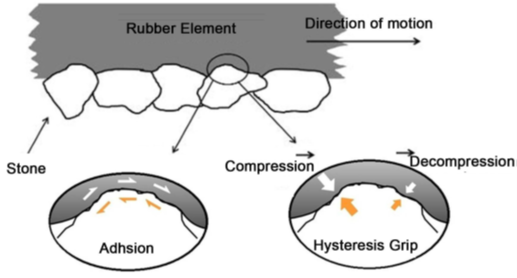
Figure 7: Schematic plot of hysteresis and adhesion. Source: Choubane, B., Holzschuher, C. and Gokhale, S. (2004)Precision of Locked-Wheel Testers for Measurement of Roadway Surface Friction Characteristics.Transportation Research Record: Journal of the Transportation Research Board, 1869, 145-151.
A softer or larger rubber surface can produce greater frictional force due to the increased true contact area under load. This explains why wider tyres exhibit superior traction.
Pulley Lagging Material Options
The Pulley Lagging material influences the following:
- The maximum traction force available.
- Whether or not there is abrasive wear and its location between the Pulley Lagging and the Conveyor Belt.
- The potential service life of the Pulley Lagging.
- The types of failure modes and their likelihood.
- Fire safety, the risk of fire and the toxicity of the fumes in the event of a fire.
- The bond strength and reliability between the steel shell of the Pulley and the Pulley Lagging.
Below are a few examples of Pulley Lagging base material options and a breakdown of each:
- Natural Rubber: Natural Rubber remains the best option when it comes to the base material for Pulley Lagging. It has a proven track record in a wide range of similar applications (vehicle and airplane tyres for example) and we have yet to synthesize an equivalent (YouTube video by Veritasium on Natural Rubber). However, it is important to understand the material datasheet when it comes to rubber, please see our article on Understanding Rubber Specifications.

- Synthetic Rubber (Styrene-Butadiene Rubber, Butyl, Chloroprene etc.): These are typically chosen to suit a particular requirement, such as cost price reduction, or flammability or high operating temperatures or acid-resistance, at the expense of service life. In standard applications, certain polymers when used as thin layers for bonding won’t have an effect on service life, however a thicker interply or cover made from these polymers will reduce the service life of the Pulley Lagging when compared to Natural Rubber.
- Polyurethane: Polyurethane makes for a poor performing Pulley Lagging product. Whilst it offers excellent abrasion resistance, it offers very low traction which is one of the primary functions of Pulley Lagging. A major risk with Polyurethane is the toxic fumes it lets off when it burns. Polyurethane is also difficult to bond on site for use as Pulley Lagging.
- Ceramic-Epoxy: Ceramic-Epoxy combinations for Pulley Lagging come in the form of alumina ceramic beads in an epoxy paste, or alumina ceramic tiles pasted to a pulley using an epoxy glue. This type of Pulley Lagging offers a high friction force (not reliable traction though as a sufficient Tread Pattern is not achievable), and very high abrasion resistance. However this type of Pulley Lagging excessively wears away the Conveyor Belt due to its rigidity. In addition, this type of Pulley Lagging tends to fail catastrophically due to it’s brittleness (a slight knock can chip off the Lagging) and the fact that large environmental temperature fluctuations are enough to cause it to debond from the Pulley as it has a different coefficient of thermal expansion to steel.
- Rubber Backed Ceramic: Rubber Backed Ceramic offers the best of both rubber and Alumina Ceramic. The rubber backing allows the the ceramic tiles to maintain static contact with the Conveyor Belt as the Conveyor Belt moves, contracts or stretches - this minimizes or prevents wear of both the Conveyor Belt and the Pulley Lagging. The Alumina tiles offer a high friction force and excellent abrasion resistance, resulting in a product that could provide the highest traction (due to little or no localised slip) and a long service life without negatively affecting the life of the Conveyor Belt (depending on the design and thickness of the specific Pulley Lagging product).
The Importance of the Tread pattern
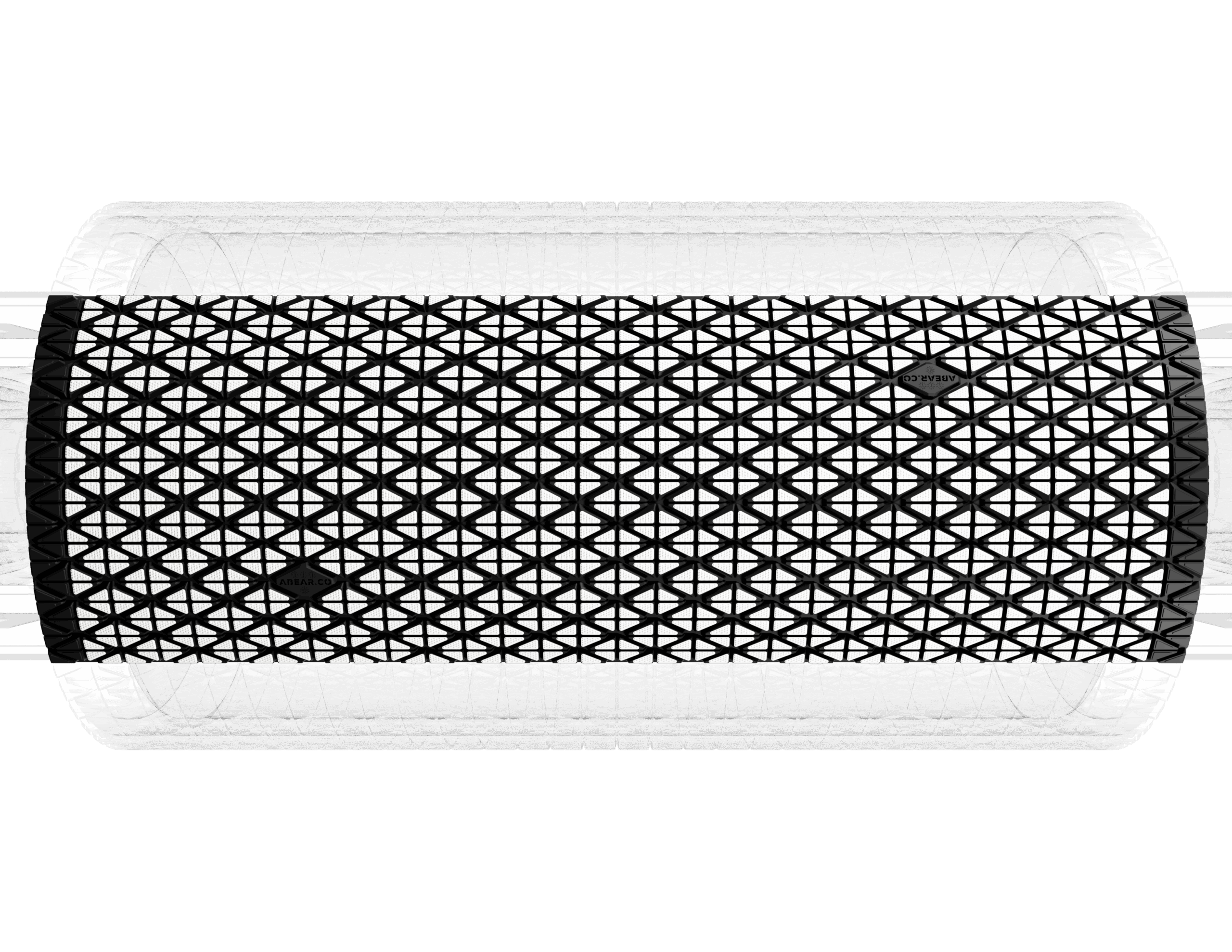
The tread pattern and design of the overall Pulley Lagging product is fundamental to its performance on site. Tread is a must have, see our article on why Plain Lagging Should be Avoided. The purpose of a tread is to continuously expel contaminants to maintain consistent surface contact. Without a tread pattern the material used as Pulley Lagging becomes irrelevant as water, mud, or fine material will accumulate between the Pulley Lagging and Conveyor Belt surfaces. A lack of Tread or a poorly designed Tread Pattern that is incapable of expelling contaminants introduces risks ranging from damage to the Conveyor Belt, Conveyor structure, Pulleys, Pulley Lagging, Drive and other components; to fire and belt misalignment.

Tread pattern DESIGN
The design of the tread pattern influences a number of aspects of the performance of the Pulley Lagging:
- The shape and pattern of the grooves influences how effectively the Pulley Lagging expels contaminants.
- The overall design influences how flexible the product is for a given material and thickness. Within reason, the more flexible the Pulley Lagging, the better it will be at maintaining traction. Our Onyx Ceramic Tread is an example of an excellent design with regards to flexibility.
- The design of the tread will either mitigate or introduce vibration which affects the service-life of components such as the bearings, gearbox and couplings. At ABEAR Industrial our products are designed with variable tread block sizes to mitigate vibration and harmonics. Products with regular patterns and/or large horizontal grooves should be avoided.
- Thicker Rubber Pulley Lagging products improve the flexibility, which in turn improves traction and reduces wear on both the Conveyor Belt and the Pulley Lagging, as well as improves the cushioning effect of the Pulley Lagging.
- Certain design aspects can further assist with tracking, such as crowning the Pulley Lagging or having rubber-only edges on Rubber Backed Ceramic products. Crowning is generally not recommended unless no other solution to belt-misalignment can be found.
- The design of the pulley lagging product has a significant influence on ease of installation and the labour hours required. For example, ABEAR HV Pulley Lagging products are designed so that a silicone strip is not required in each groove during installation, but only at the joins, which dramatically reduces man-hours and cost when compared to competitor products.